
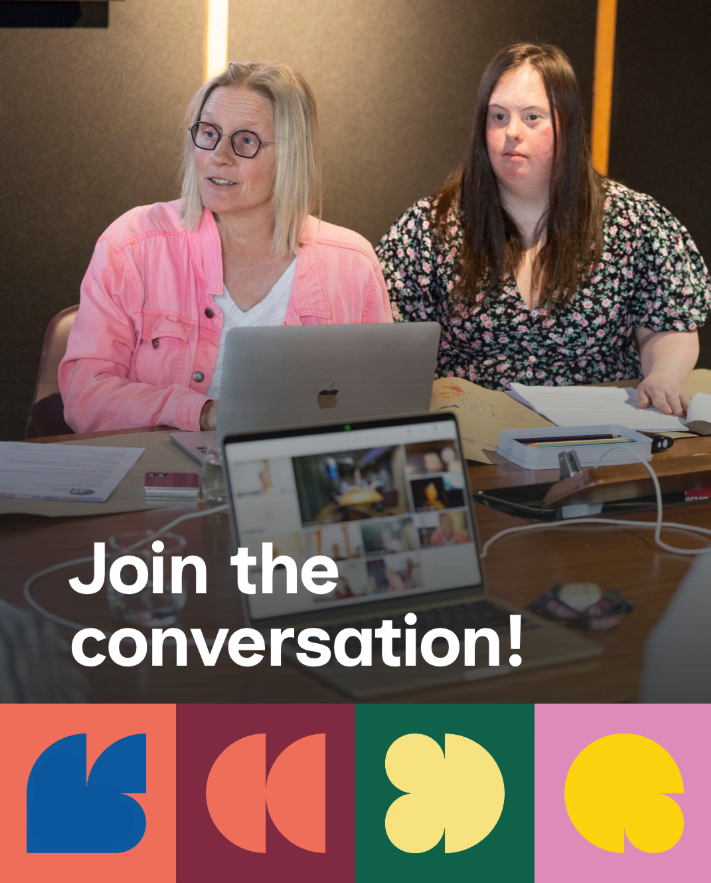
In September, Annalise and Kelly packed up SEE’s questions, drawings, ideas and a very long roll of brown paper and headed to Brisbane for our first national meeting as part of the Arts and Disability Network Australia (ADNA).
Over two days, that paper became a kind of weather map of the meeting. Spirals. Rivers. Hands. Bridges. Questions. Exclamation marks. Ideas written sideways and upside down. Notes running into other people’s notes. Which, it turns out, is a pretty good picture of what happened.
We talked about access for all Australians, disability-led leadership, community, advocacy, government policy, NDIS change, regional voices, First Nations and culturally diverse communities, complex disability, digital access, funding, care and the slightly enormous question of what ADNA might become.
There was plenty to wrestle with.
How do we make access something built into everything, rather than a separate box to tick? How do we stop measuring success only through outputs and start measuring what actually changes? How do artists and communities contribute to decisions from the beginning? How might art itself become a form of advocacy, rather than always translating lived experience into another report?
And how do we create systems with enough time, trust and flexibility for people to participate in ways that actually work for them?
Somewhere among all of this, our notes acquired a bridge, a worry board, several galaxies, a DNA strand, a handful of community voices and the excellent instruction: CAN ART SOLVE THE PROBLEM. It made us think of LET THE ART SPEAK and letting ART be the creative solution.
A Society in Rehearsal
Annalise and Kelly also shared SEE’s presentation, A Society in Rehearsal, about how our way of making art might offer some clues for changing bigger systems.
We began, as we often do, with meditation. Then we talked about relationships, time, different ways of thinking and communicating, access as creative infrastructure, lived experience as expertise, and what happens when people who have traditionally been designed around become the designers.
Our argument was fairly simple: changing who has authorship changes the art, and it can change the culture around it too.
The presentation ended with everyone offering a reflection and a moment of gratitude.
For Annalise, that became one of the most important parts of the whole trip.
“It was a wonderful journey to make new solutions, to break free and ignore negativity. To make connections. To work and socialise with colleagues. I loved the reflections, the gratitude, the emotion and the care.” - Annalise Haigh
That spirit ran through the meeting. Alongside the big policy questions were conversations about gentleness, collective leadership, listening differently, making room for uncertainty and taking time before rushing towards the next solution. The wider ADNA discussions kept returning to community contribution, genuine partnership and the need for systems that value knowledge carried through lived experience, culture and relationships.
We came back to Lutruwita with no neat diagram of the future.
Good.
We came back with new colleagues, more questions, some possible solutions, a roll of paper covered in collective thinking and a stronger sense that ADNA does not have to simply reproduce the structures that already exist.
It can rehearse something else.
And, naturally, Every Story Counts.